
An informative material produced by a participant in the Media Fellowship activity, illustrating the role of women in conflict prevention, facilitating dialogue and building trust in communities from the perspective of the WPS Agenda and the Triple Nexus.
The Institute for Democracy and Development (I4DD) is sharing the informative material “The Role of Women in Conflict Prevention and Strengthening Dialogue”, produced by Tatiana Sandu, a participant in the Media Fellowship course. The Media Fellowship is carried out within the regional project “Local Women Peacebuilders’ Comparative Advantage: Integrating WPS in the Triple Nexus of Humanitarian Action, Development and Peacebuilding”, implemented by I4DD in partnership with the Global Network of Women Peacebuilders (GNWP), with financial support from the Austrian Development Agency (ADA). The material draws public attention to the role of women in preventing conflict, facilitating dialogue and building trust in communities – central themes of the Women, Peace and Security (WPS) Agenda and of the Triple Nexus approach (humanitarian – development – peace).
View the material and discover how participation, trust and dialogue can prevent conflict and strengthen communities.
Why women’s participation matters
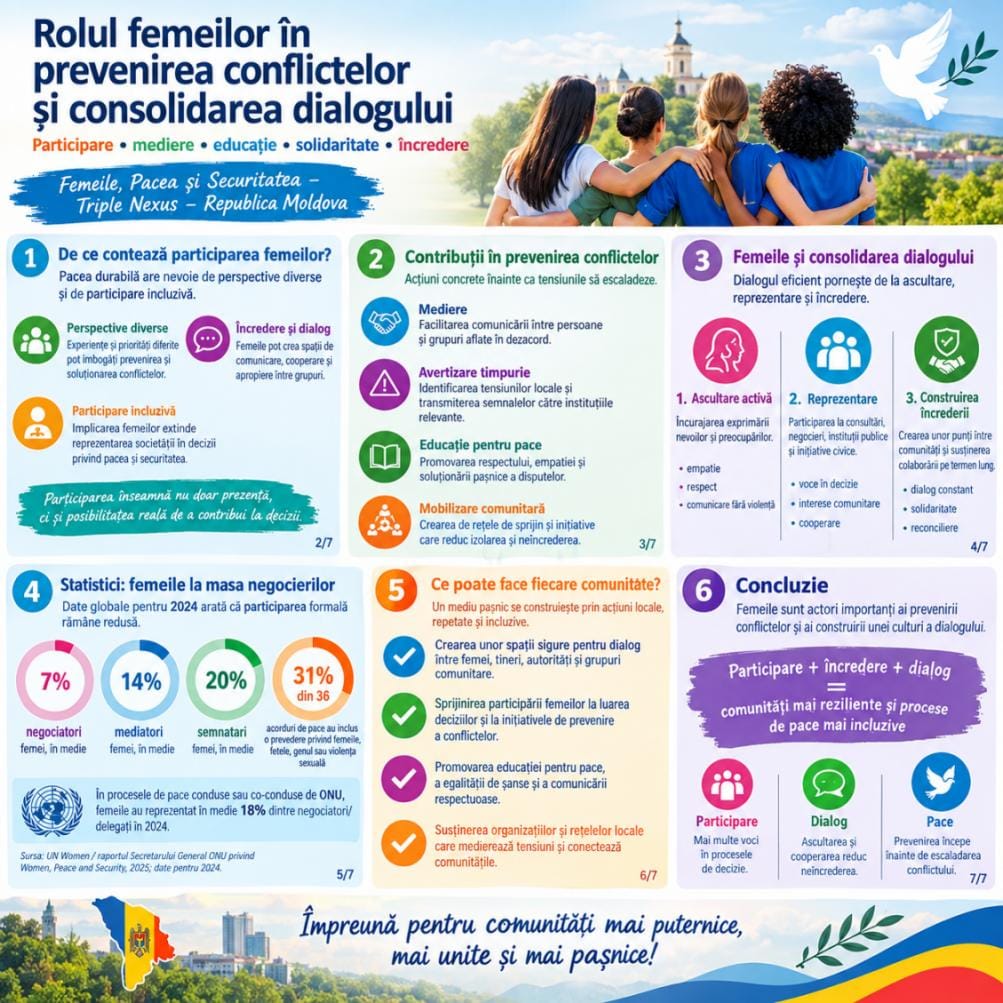
Conflict prevention begins with the early identification of tensions, mediation, peace education and community mobilisation. Open communication, active listening and involvement in decision-making processes can help resolve problems before they escalate.
Although the role of women in preventing and resolving conflict is increasingly recognised, women remain underrepresented in formal peace processes. According to the UN Secretary-General’s Report on Women and Peace and Security (2025), in 2024 women accounted on average for only 7% of negotiators, 14% of mediators and 20% of signatories to peace agreements, and nearly nine out of ten peace processes had no women negotiators at all. Even in processes led or co-led by the United Nations, women made up on average 18% of negotiators and delegates. It is therefore important that women have real opportunities to take part in dialogue, consultations and conflict prevention initiatives, both at national level and in their own communities.
The story
One example is Tatiana, a communication and psychology specialist working in a state institution. Her professional work focuses on the integration and development of employees, strengthening internal communication and fostering a positive organisational climate. For her, communication and engagement are essential tools for building relationships based on respect and trust – values she promotes both in her professional work and in everyday life.
Her experience shows that conflict prevention is not only a matter of high-level negotiations, but also of how people communicate, listen to one another and cooperate every day – in institutions, in the workplace and in the community.
Triple Nexus dimensions reflected in the material
The material highlights the interdependence of the three pillars of the Triple Nexus:
- Peace – prevention, mediation and dialogue. Mediation, early warning and non-violent communication make it possible to manage tensions before they escalate. Women’s participation brings diverse perspectives and contributes to solutions that are closer to people’s real needs.
- Development – inclusive institutions and trust. An organisational climate based on respect, communication and cooperation, including within state institutions, strengthens their capacity to respond to citizens’ needs. Women’s representation in decision-making contributes to more inclusive governance and greater trust in institutions.
- Humanitarian dimension – solidarity and community resilience. Support networks and community mobilisation reduce isolation and mistrust and prepare communities to cope with crises. United communities, where people listen to one another and cooperate, are better prepared to prevent and overcome shocks.
The material thus conveys a key message of the WPS Agenda: participation, trust and dialogue are preconditions for preventing conflict and building more united and resilient communities, and women are key actors in this process.
An example of gender-sensitive journalism
The woman is portrayed as a professional and an agent of change, through her skills and contribution, rather than as a passive recipient of support. The focus is on prevention and solutions – active listening, representation and trust-building – offering a concrete example of how the media can help promote gender equality, women’s participation and human security.
About the Media Fellowship
The Media Fellowship is an activity of the project “Local Women Peacebuilders’ Comparative Advantage: Integrating WPS in the Triple Nexus of Humanitarian Action, Development and Peacebuilding”, implemented by I4DD in partnership with GNWP, with financial support from ADA. It aims to strengthen journalists’ capacity to cover topics related to the Women, Peace and Security Agenda and the Triple Nexus approach in an ethical and gender-sensitive manner. The materials produced by participants help inform the public and promote women’s active participation in community life.
Peace is built together – through every conversation held with respect, every tension prevented and every voice given the space to be heard.
I4DD
Note on the content of the material
I4DD shares this graphic material for information purposes, in the form in which it was produced by its author. The content of the material belongs solely to the author and does not necessarily reflect the official position of I4DD, GNWP or the Austrian Development Agency. The statistics presented are taken from the UN Secretary-General’s Report on Women and Peace and Security (2025) and refer to 2024.
The graphic material contains no personal data. The images used are illustrative and do not allow the identification of specific individuals.
 English
 Romanian