
The second video produced by a participant in the Media Fellowship activity, illustrating the role of women in community development, social cohesion and local resilience from the perspective of the WPS Agenda and the Triple Nexus.
The Institute for Democracy and Development (I4DD) is sharing the video “Coming Home to Build: How a Woman from Cuhnești Empowers Women Returning from Abroad to Develop Their Community”, the second media product created by journalist Dorin Rusu (TV Nord), a graduate of the Media Fellowship course. The Media Fellowship is carried out within the regional project “Local Women Peacebuilders’ Comparative Advantage: Integrating WPS in the Triple Nexus of Humanitarian Action, Development and Peacebuilding”, implemented by I4DD in partnership with the Global Network of Women Peacebuilders (GNWP), with financial support from the Austrian Development Agency (ADA). The video shows how one woman’s initiative can mobilise an entire community, and how women, including those returning from abroad, can become drivers of local development, social cohesion and resilience – central themes of the Women, Peace and Security (WPS) Agenda and of the Triple Nexus approach (humanitarian – development – peace).
Watch the video and discover how one woman’s initiative can bring a community together.
Video: Dorin Rusu / TV Nord
The story
Diana Olievschi is the founder of the Public Association “Asociația Băștinașilor Dor de Acasă, Dor de Cuhnești” (Association of Natives “Longing for Home, Longing for Cuhnești”). Through the association’s initiatives – including the Generations Park and the project “Femeile Moldovei Revin Acasă” (“Moldova’s Women Come Back Home”) – she has turned homesickness into a reason to return and to take part in village life. Workshops in folk dance, traditional blouse (ie) embroidery, cooking and woodcarving have brought together local women and natives who have returned from the diaspora, creating new opportunities for socialising, learning and cooperation.
Interviews with women from Cuhnești capture the changes these initiatives have brought about: more communication, the courage to express their opinions, new interests and a desire to take an active part in community life. The association’s cooperation with the village school extends these benefits to the younger generation as well.
Triple Nexus dimensions reflected in the material
Although it starts from a local initiative, the story highlights the interdependence of the three pillars of the Triple Nexus:
- Development – unlocking the potential of women and the diaspora. Returning home brings experience, skills and ideas into the community that can be invested in local initiatives. Women’s involvement in revitalising the village, including through the promotion of local cultural heritage, contributes to inclusive and sustainable local development.
- Peace – social cohesion and participation. Shared spaces such as the Generations Park, and activities that bring together local residents and returning natives, reduce isolation, rebuild ties between people and generations, and strengthen trust – the foundation of peaceful communities able to manage differences through dialogue.
- Humanitarian dimension – solidarity and community resilience. The women’s networks formed around the association are social capital that can be mobilised quickly in times of crisis to support vulnerable people. United and organised communities are better prepared to prevent and overcome shocks.
The video thus conveys a key message of the WPS Agenda: women are not merely beneficiaries of development, but leaders who identify community needs and mobilise people around shared goals. As Diana Olievschi emphasises, women need to be heard, understood and supported in order to contribute to a more empathetic and united society.
An example of gender-sensitive journalism
The video reflects the skills developed through the Media Fellowship and the principles of gender-sensitive journalism. The women of Cuhnești are the protagonists and main sources of the story, which is told in their own voices rather than through intermediaries. The focus is on initiative and agency: Diana Olievschi and the women of the community are portrayed as agents of change, not as mere recipients of external support.
The local experience is placed within a broader public-interest context – migration, returning home and the revitalisation of rural communities – offering a concrete example of how the media can help promote gender equality, women’s participation and human security.
About the Media Fellowship
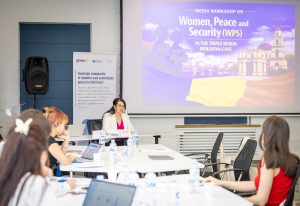
The Media Fellowship is an activity of the project “Local Women Peacebuilders’ Comparative Advantage: Integrating WPS in the Triple Nexus of Humanitarian Action, Development and Peacebuilding”, implemented by I4DD in partnership with GNWP, with financial support from ADA. It aims to strengthen journalists’ capacity to cover topics related to the Women, Peace and Security Agenda and the Triple Nexus approach in an ethical and gender-sensitive manner. The materials produced by participants help inform the public and promote women’s active participation in community life.
When women returning home are supported to make use of their experience, they become the driving force of community development. The story of Cuhnești shows that women’s participation is a direct investment in social cohesion and local resilience.
I4DD
Note on content and personal data protection
I4DD shares this video for information purposes, in the form in which it was produced and published by its author. The statements and opinions expressed in the video belong solely to the interviewees and the journalist and do not necessarily reflect the official position of I4DD, GNWP or the Austrian Development Agency.
The personal data included in the video (name, image, voice, information about personal circumstances) were collected and processed by the author of the video. I4DD does not collect, store or process these data for any purpose other than sharing the video, in compliance with Law No. 195/2024 on the protection of personal data. Any requests regarding these data may be addressed to the author of the video or to I4DD.
 English
 Romanian