
The second informative material produced by a participant in the Media Fellowship activity, showing how stereotypes can limit opportunities and participation, from the perspective of the WPS Agenda and the Triple Nexus.
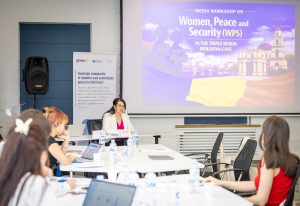
The Institute for Democracy and Development (I4DD) is sharing the informative material “Combating Stereotypes and Promoting Equal Opportunities”, the second material produced by Tatiana Sandu, a participant in the Media Fellowship course. The Media Fellowship is carried out within the regional project “Local Women Peacebuilders’ Comparative Advantage: Integrating WPS in the Triple Nexus of Humanitarian Action, Development and Peacebuilding”, implemented by I4DD in partnership with the Global Network of Women Peacebuilders (GNWP), with financial support from the Austrian Development Agency (ADA). The material highlights how stereotypes and prejudice shape the perceptions, decisions and opportunities offered to people, sometimes contributing to the perpetuation of discrimination and inequality – a topic closely linked to the Women, Peace and Security (WPS) Agenda and the Triple Nexus approach (humanitarian – development – peace).
View the full graphic material below.
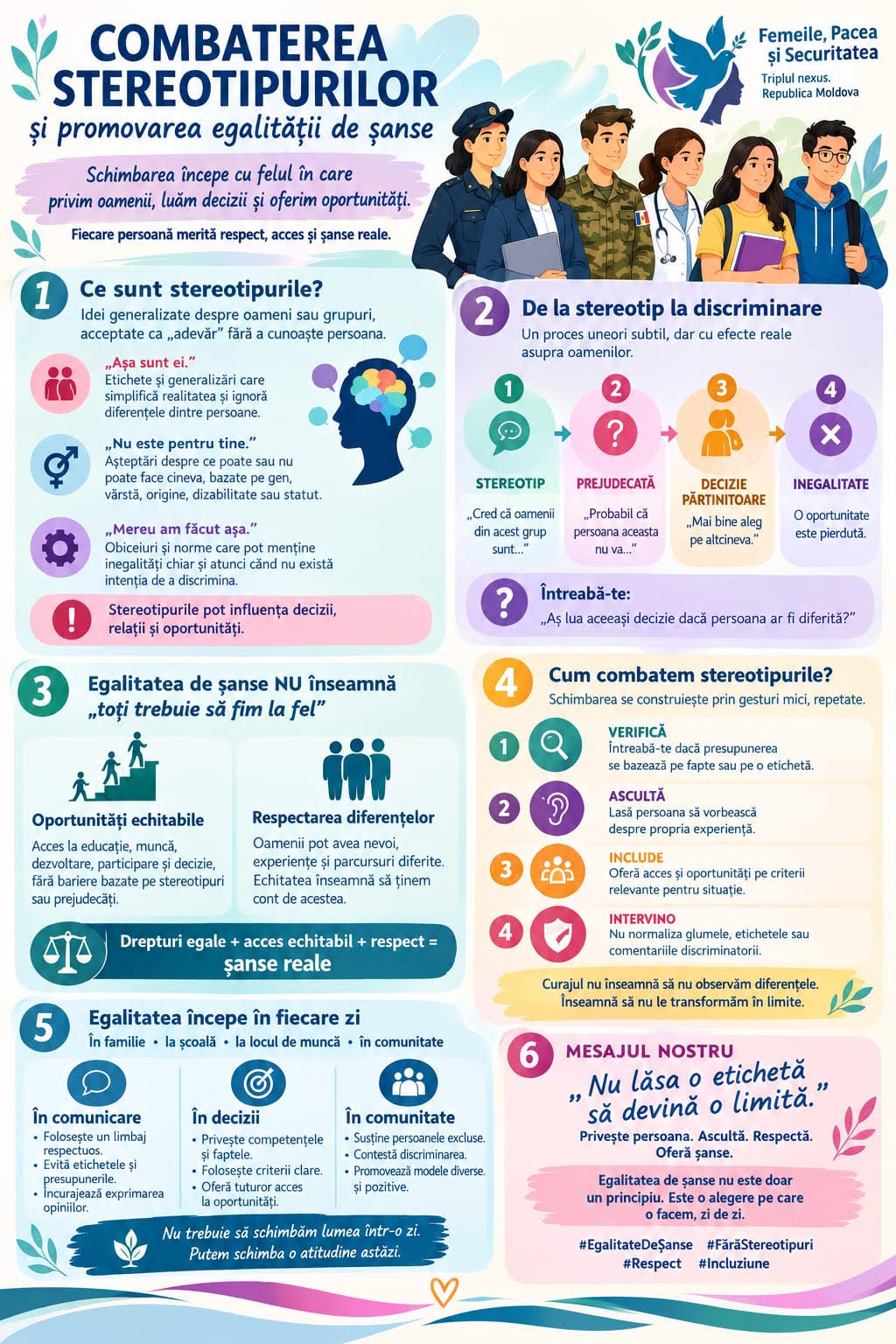
From stereotype to discrimination
Stereotypes are generalised ideas about people or groups, accepted as “truth” without knowing the person. They take the form of labels (“That’s just how they are”), expectations based on gender, age, origin, disability or status (“It’s not for you”), and habits that sustain inequality even when there is no intention to discriminate (“We’ve always done it this way”).
The material describes the often subtle process through which a stereotype becomes prejudice, prejudice leads to a biased decision, and a biased decision results in inequality – a lost opportunity. To break this chain, the author suggests a simple question: “Would I make the same decision if the person were different?” The material also clarifies that equal opportunities do not mean that we all have to be the same, but that equal rights, equitable access and respect create real opportunities for everyone.
Practical recommendations
The material proposes four simple actions that can be repeated every day:
- Check whether an assumption is based on facts or on a label.
- Listen to the person and let them speak about their own experience.
- Include – offer access and opportunities based on criteria relevant to the situation.
- Speak up – do not normalise discriminatory jokes, labels or comments.
The recommendations address communication (respectful language, avoiding labels), decision-making (assessing people on the basis of skills and facts, clear criteria, access for all) and community life (supporting excluded people, challenging discrimination, promoting diverse and positive role models) – in the family, at school, in the workplace and in the community.
Triple Nexus dimensions reflected in the material
Combating stereotypes is relevant to each of the three pillars of the Triple Nexus:
- Peace – preventing tensions and social cohesion. Labels and prejudice fuel mistrust, exclusion and polarisation. Respectful communication and responding to discriminatory comments prevent tensions from escalating and strengthen trust between people and groups.
- Development – equitable access to education, employment and decision-making. Assessing people on the basis of their skills and actions, rather than stereotypes, allows everyone’s potential to be realised and contributes to inclusive development in which women and other underrepresented groups have real opportunities to succeed.
- Humanitarian dimension – responses that take everyone’s needs into account. In crisis situations, stereotypes can cause the needs of certain groups of people to be overlooked. Recognising that people have different needs and experiences is a precondition for an inclusive and effective humanitarian response.
The material thus conveys a key message of the WPS Agenda and UN Security Council Resolution 1325: the full and effective participation of women in public life, including in the security and defence sector, requires removing the barriers created by stereotypes and prejudice. To this end, the material’s illustrations show women and men in a variety of professions, including the police, the armed forces and medicine.
An example of gender-sensitive journalism
The material offers practical tools and positive role models, with a clear central message: “Don’t let a label become a limit.”
About the Media Fellowship
The Media Fellowship is an activity of the project “Local Women Peacebuilders’ Comparative Advantage: Integrating WPS in the Triple Nexus of Humanitarian Action, Development and Peacebuilding”, implemented by I4DD in partnership with GNWP, with financial support from ADA. It aims to strengthen the capacity of journalists and communicators to cover topics related to the Women, Peace and Security Agenda and the Triple Nexus approach in an ethical and gender-sensitive manner. The materials produced by participants help inform the public and promote women’s active participation in community life.
Equal opportunity is not just a principle. It is a choice we make, every day.
from the material produced by Tatiana Sandu
Note on the content of the material
I4DD shares this graphic material for information purposes, in the form in which it was produced by its author. The content of the material belongs solely to the author and does not necessarily reflect the official position of I4DD, GNWP or the Austrian Development Agency.
The graphic material contains no personal data. The images used are illustrative and do not allow the identification of specific individuals.
 English
 Romanian